
Methodologies and Tools
Unmanned vehicles (ground and aerial: UGV and UAV) are proposed as fundamental allies for new detection technologies approaching the ground e tanks to the skills of the project partners, a latest generation UGV will be developed.
Currently, computer vision is customized and specific applications are available. The same technology will be used to adapt to military requirements, together with information from other sensors.
The UGV will integrate several capabilities, tailored to the project's mission profile:
- Semi-autonomous and (under certain circumstances) fully autonomous navigation in unknown environments and improved mobility characteristics, to tackle various terrains, representative of military applications.
- Acquisition and fusion of data from different types of sensors, for effective threat detection, classification and identification, using AI and ML-DL algorithms.
- Installation of a precision handling robotic arm, capable of performing delicate tasks, such as sampling, while carrying an array of sensors to contribute to threat detection tasks and improved navigation.
- Communication with MGV and GCS for assignment of tasks and provision of LOP.
These platforms can be used either as:
- a member of a swarm system, performing specific tasks in cooperation with other members under the supervision of a high-level mission planner (HLMP);
- an autonomous subsystem for executing a complete mission, which will include several tasks in a logical sequence.
In both cases, task prioritization should take place based on customized AI algorithms.
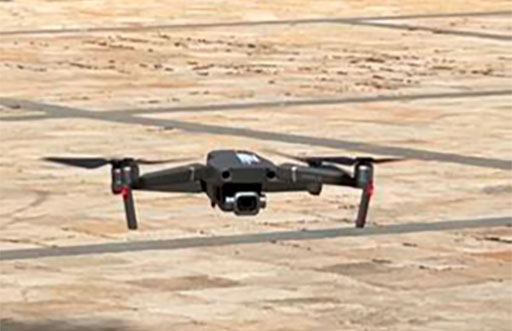
Low-cost Mini UAVs equipped with advanced chemicals vapor sensors in semi-autonomous flight campaigns are used achieving a real-time cooperation with ground systems, such as UGVs. Their operational configuration is different from the current one, representing an advantage in all level of operations compared to the currently available systems. The proposed system performs a multistage scheme to perform accurate scanning, saving valuable resources for preliminary areas marked as dangerous, and sensor fusion (e.g. with vapor sensors) improving the target confirmation and identification.
Project Summary
The TICHE project aims to develop a novel multiplatform collaborative solution to detect and characterize improvised explosive devices (IEDs) and landmines in complex environments, using a combination of advanced sensors, information fusion from these sensors, and unmanned ground and aerial systems to extend the detection capabilities.
The developed solution will integrate both proven and experimental sensors, aiming to improve the state-of-the-art in hidden threats detection but also in terms of power consumption, transportability, communication, interfacing capability and continuous operation.
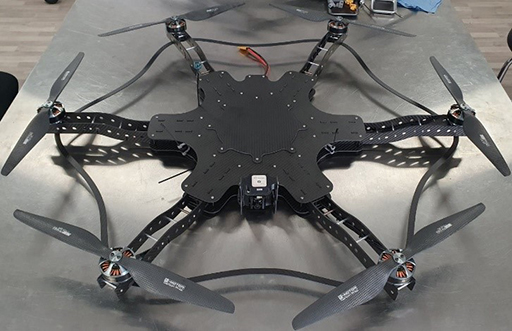
In the called scenario, collaborative UGV, mid size UAV and a swarm of hand size UAVs have the potential to be the most effective multiplatform solution for speed of intervention, automation, surveying, detection, sampling, identification and mapping the suspected area and therefore for retrieving critical information in supporting of military operations and lifesaving.
Innovative Content
TICHE project addresses the improving the detection and characterization of hidden explosives IEDs and land mines in complex environments, proposing a multidisciplinary investigation approach in which both new detection technologies and new methods and processes for their exploitation in the real field will be developed in a new collaborative cross-platform solution.
Advanced sensors and related information, in combination with ground and unmanned aerial systems, will be used to extend sensing capabilities. Specific upgrading and specialization is aimed at the vapor gas analyzer for rapid response, while other standard technologies (GPR, gas chromatography, hyperspectral imaging, gamma spectroscopic detectors, chemical microsensors) will be calibrated for the target of the challenge.
The adoption of data processing algorithms based on AI technologies completes the approach for detection and characterization.
Energy consumption, transportability, communication, interface capability and continuous operation are considered proposing new technologies.
Data Fusion and AI Image Processing
Sensor fusion (e.g. with vapor sensors) is also believed to improve target confirmation and identification. This type of hybridization is completely new and is expected to pave the way towards highly efficient detection, confirmation and identification systems for IEDs and landmine detection.
AI image processing algorithms for object detection and classification of IEDs and land mines will be developed using a series of images capturing different (possibly overlapping) areas as the sensors move with the UxVs (i.e. UGV and UAV).
Although the outcome of TICHE will be a relatively low TRL, it will form the basis on which commercial HTD products can be developed. Such marketable systems for HTD do not currently exist and therefore their development is innovative and brings the necessary solution to the problem of detection and classification of hidden threats.