
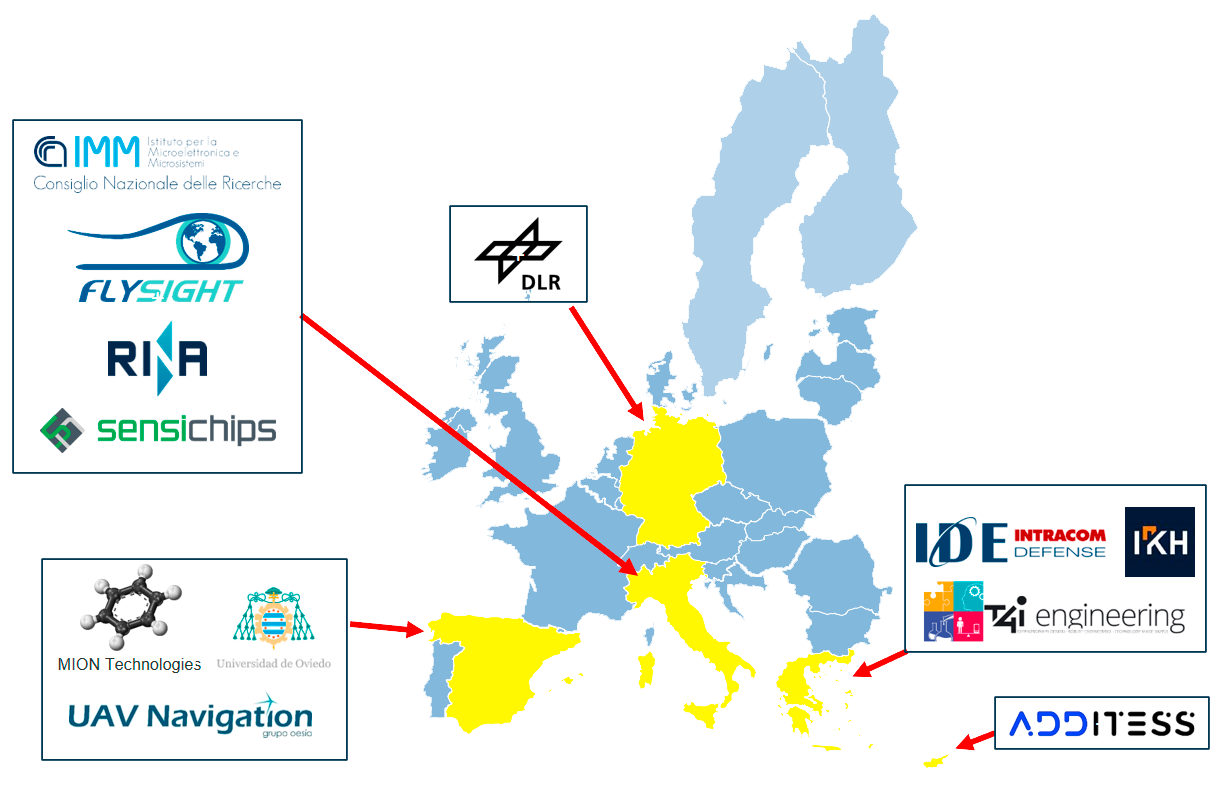

RINA-CSM is a fully private innovation center, founded in 1963 by Italy’s major steel industry, with extensive experiences for the development and application of innovative processes and materials. Today CSM is part of RINA Group. CSM is a leading center for applied research activities mainly related to the modelling and design of materials and products, development of innovative pilot plants and reduction of environmental impact. With a staff of about 300 researchers, CSM ranks among Europe’s top Materials Research Centers. The industrial sectors of main interest to the Company are: Energy and environment, Iron and steel, Oil and gas, Aerospace and defense, Mechanics and transport.

MION Technologies is a Spanish SME company that develops, manufactures, and commercializes analytical instrumentation, mainly EVDs (Explosive Vapor Detectors) based on its DMA (Differential Mobility Analyzer) technology for the detection of different threats not limited to explosives, such as narcotics, chemical agents, and other illicit substances.
MION's EVD technology has reached unprecedented limits of detection in the range of sub-ppq (parts per quadrillion) which provides very versatility allowing the implementation of the technology into almost any scenario such as air cargo, maritime cargo, trucks, pallets, boxes, mail, passengers, suitcases, landmines, IEDs, etc.
MION company is based on a multidisciplinary team with vast experience in vapor detection technologies with two main pillars: talent in the team and continuous research which is the key to our outstanding results.

SCP is an Italian SME (Small and medium-sized enterprises) developing safety system
microsensors. It
brings together a unique combination of expertise in microelectronics, materials science, analytical
chemistry, nanotechnologies, and artificial intelligence to engage in the development of a next generation
learning microsensors platform. Miniature sensors include diverse sensor types, signal conditioning,
acquisition electronics and synergetic coordination to improve classification in a single microchip. The
chips measure just 3×3 mm, offering an integrated microsensor IC platform with low power consumption.
Powerful detection capabilities include chemical, radiological, materials diagnostics and
electrochemistry.
In the field of battery monitoring, the single chip EIS (Electrochemical Impedance Spectroscopy plus
Electrochemical Potentiostat and Galvanostat) for individual or daisy cells monitoring of State Of Charge
(SOC), State Of Health (SOH), State of Power (SOP) and safety parameters. The high level of
miniaturization allows embedding virtually in any battery cell form factor. SENSICHIPS is part of the
Arescosmo/Aero Sekur Spa industrial group. SENSICHIPS is responsible of the development of a demonstration
Battery Management System (BMS) along with the battery sensorization for stationary system batteries.

ADDITESS - Advanced Integrated Technology Solutions & Services Ltd is a Cyprus-based
Small Medium
Enterprise (SME) established in 2011. ADDITESS is a scientific, consulting, and research company whose
purpose is to conduct theoretical and applied research and to produce studies and to develop state of the
art applied Security Solutions hardware or software based, at strategic and tactical level, on issues
concerning Security policies, Border Management, Critical Infrastructure Protection, Cyber-Security and
also in the above-mentioned areas.
Over the last years ADDITESS invested in establishing the role of the company through strong participation
in EU and National R&D funded projects, in the fields of Security, ICT, Aeronautics (UAVs),
Communications, Transportation and Environment.
ADDITESS core competencies span across 3 distinct business units:
- Sofware Enginnering
- Digital Transformation Products
- Robotics Products - Services
CNR The National Research Council (CNR) is a public national research body with multidisciplinary skills, supervised by the Ministry of University and Research (MUR).
The Section of Bologna of the Institute for Microelectronics and Microsystems (CNR-IMM-BO) is a multi-disciplinary research center working on the study of materials and devices for microelectronics. The synergy between physicists, engineers and chemists provides a global approach to material and device studies, overcoming the classical divisions between disciplinary areas. CNR-IMM-BO can embrace a wide area of knowledge, spanning from material characterization to the study of technological processes, and the design and fabrication of integrated devices.
CNR-IMM-BO has one of the biggest publicly funded facilities for silicon micro-machining in Italy (located in a 500m2 clean-room with 100 and 1000 classrooms), capable of producing different non-VLSI devices, in particular micro-electro-mechanical-systems (MEMS), using micro-machining techniques for Si, SiC and Quartz substrates, and 3rd generation solar cells and photovoltaic devices.
High-TRL development of gas sensors and MEMS-based gas-chromatographic systems is one of the core activities of IMM-BO.

The German Aerospace Center (DLR) is the Federal Republic of Germany's research center
for aerospace,
energy, transport, digitalization and security in the field of applied sciences and basic research. It is
headquartered in Cologne and is represented at another 30 locations in Germany and 4 offices abroad. In
its research and development work DLR cooperates with other research institutions and industry
worldwide.
DLR is responsible for the planning and implementation of German space program activities on behalf of the
Federal Government. Two DLR project management agencies manage funding programs and support knowledge
transfer. DLR uses the know-how of its more than 55 institutes and facilities to develop solutions for the
challenges of today and the world of tomorrow. More than 10,000 employees have a common mission: We
research and develop technologies for a sustainable future. In this way, we contribute to strengthening
Germany as a knowledge and business location.

FLY is the Defense and Security division of Flyby Srl, an Italian hi-tech group
specializing in the development of Decision Support Systems (DSS) that leverage cutting-edge technologies
in Signal Processing and Big Data Analytics.
The FlySight team offers expertise in designing and developing state-of-the-art C4ISR systems (Command,
Control, Computer, Communication for Intelligence Surveillance, and Reconnaissance).
Their solutions are rooted in Artificial Intelligence (AI) methodologies, harnessing the power of advanced
cognitive signal processing and adaptive data fusion algorithms. Primarily applied in avionics, naval, and
underwater domains, the solutions provide geospatial situational awareness for both on-ground and on-board
segments, offering multi-domain, cross-platform, and open code solutions.
Real-time Processing, Exploitation, and Dissemination (PED) is seamlessly achieved through the integration
of our products into existing architectures, thanks to the interoperability of our systems with STANAG and
OGC (Open Geospatial Consortium) standards. Furthermore, the incorporation of Deep Learning methodologies,
combined with Augmented Reality, enables the creation of disruptive ISTAR (Intelligence Surveillance
Target Acquisition and Reconnaissance) systems.

INTRACOM DEFENSE (IDE) is a highly acclaimed Defense Systems Company in Greece, with an
outstanding record
of participation in domestic programs and exports to quality-driven international customers.
IDE utilizes high-end technologies in the design and development of advanced products in the areas of
Missile Electronics, Tactical Communications, Surveillance, Hybrid Electric Power Systems, and Unmanned
Systems. The Company retains its international recognition through the long standing participation in
European and NATO new technology development programs. Utilizing advanced R&D & manufacturing capabilities
and large-scale project management know-how, IDE is a key player in the high technology sector of the
Hellenic Defense Industry.

Founded in 2002 in Athens iKnowHow is a Greek SME of around 130 employees that provides custom-built robotics and automation solutions to the industry and software solutions to the public and private sectors. During 2016, IKH merged with Innora, a highly innovative robotics and control company, and has transformed into a one-stop-shop when it comes to robotics, embedded systems, AI, ML and computer vision combined into data-driven intelligence.
iKnowHow delivers a comprehensive range of state-of-the-art solutions, compliant to ISO 9001:2015, 27001, 14001 and 13485 standards, to fit the needs of the end customer. Since 2002 iKnowHow has executed more than 60 large scale product development and commercialisation projects in the private and public sector.
The past years the company has significantly increased in size and financial yield, reaching almost 120 employees and a raise of 600% in turnover. As an example of iKnowHow's continued growth, the company acquired in 2014 Evorad SA and further developed a medical imaging tool for radiologists with a portfolio of over 50 large B2B clients in the EU and the US.
iKnowHow's core competencies span across 3 distinct business units:
-
Digital Health
- Evorad
-
Digital Transformation
- Digital Government
- Industrial Internet
-
Robotics, IoT & Automation
- Service Robotics, UGVs | simulators, mechatronics, industrial design, inspection, NDT
- Data Driven Intelligence | computer vision, cognitive control, human-machine interfaces
- Internet of Things | embedded control, instrumentation, connectivity
- AI and ML

T4i is an SME, founded in 2014 as a start-up at Loughborough, UK, operating at the Advanced Technology Innovation Center of Loughborough University, and since 2019 in Athens, Greece.
T4i delivers experience and know-how for solutions, applications and services in the areas of chemical analysis and technology, specialized in the electronic design and materials science and in the development of advanced chemical detectors for field use, including handheld. Company core innovation is the design of modular, miniaturized, and adaptive detectors.
T4i engineering experience ensures high quality project management and risk analysis for R&D projects and offers custom-fit solutions in the areas of security/defense, safety, sensors development, environmental monitoring by using state-of-the-art chemical detectors on-board UAVs. T4i collaborates with UAV and robot providers for mounting chemical detectors on-board unmanned platforms being active in security and defense research & innovation.

UAV Navigation-Grupo Oesía specializes in designing guidance, navigation, and control solutions (GNC) for Unmanned Aerial Vehicles (UAVs) since 2004. Our control solutions are renowned for their reliability and robustness, and they are applied across diverse platforms, including rotary-wing platforms, fixed-wing platforms, aerial targets, and VTOL platforms. Our success lies in a comprehensive, in-house capability to develop Attitude & Heading Reference Systems (AHRS), flight control algorithms, and integrate data provided by multiple sensors.
As part of the TICHE consortium, we contribute our expertise in GNC and UAVs to help build the complex TICHE system, sharing our knowledge and capabilities.

The University of Oviedo is a Spanish public institution of higher education founded in
1608 in
Principality of Asturias, in Northern Spain and focuses its main functions in teaching, study and research
and collaborates with more than 250 companies.
It is a medium-size university with more than 2,000 lecturers and 38 Departments encompassing a wide range
of fields of specialization, including the areas of Sciences, Engineering & Architecture.
University of Oviedo has a well-established network of partners at a global scale to offer academic
programs in all the branches of knowledge and promotes R & D in the region. It fosters the transfer of
knowledge and innovation to the business and industrial sectors.
The research group TSC-UNIOVI of this university contributes with technologies for landmines and IEDs
detection based on UAVs and GPR for a safe detection of threats with minimum risk.