Improvised explosive devices (IEDs) and landmines are a significant threat to military personnel, civilians
and equipment, and a major cause of casualties for European forces during operations. Countering these hidden
threats is essential to protect soldiers, reduce loss of equipment, secure critical logistic activities,
improve mobility and freedom to act by increasing the security of operation areas, and more generally enhance
operational efficiency.
In addition, IEDs are increasingly used in urban scenarios where the detection is more difficult, especially
if multiple IEDs emplacements are used. In particular, they have the potential to severely disrupt both
military and civilian supply chains, damage critical infrastructures and affect strategic lines of
communication.
Detecting these hidden threats is an essential step. Since they are by design difficult to detect for humans,
automatic detection technologies can play an important role. However, the task is intrinsically difficult, and
the performance of existing technologies is still far from answering the needs.
With a Consortium made of 12 beneficiaries from 5 EU countries, TICHE will participate in this technological
challenge by developing a novel multiplatform collaborative solution to detect and characterize hidden
Improvised Explosive Devices (IED) and landmines in complex environments, using a combination of advanced
sensors, information fusion from those sensors, and unmanned ground and aerial systems to extend the detection
capabilities. The developed solution will improve the state-of-the-art in support of military operations and
lifesaving.
The project is aimed to enhance detection technologies, especially for scenarios where single detection
devices are not sufficient and the use of distributed sensors is deemed useful.
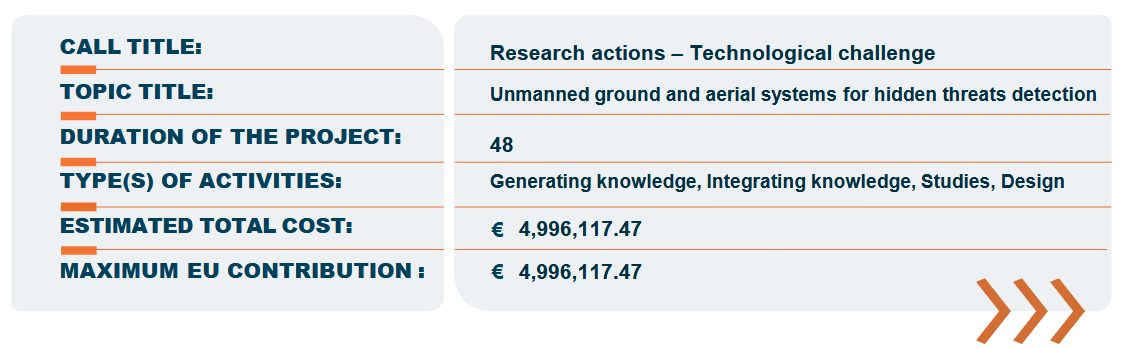
The duration of the Project is set to 48 months and the starting date is the 1th of December 2023. The maximum
grant amount is €4,996,117.47 and covers the estimated eligible costs and contributions.